Say it your way.

Voice assistants don't understand people with dysarthria. Utter learns how one person speaks, from three of their own recordings per word, and then says the full sentence for them.

The phone on this page is the app's real interface and you can click through it. It is a demo: nothing is recognised here and the microphone is not used. It replays answers the real app gave on real recordings. The real recognition runs in the app you download.
Launch video

The whole idea in a minute and a half, with real recordings from the TORGO database.

The problem, measured

After a stroke, or with Parkinson's, ALS or cerebral palsy, speech often becomes slurred and slow, and hands often don't work well either. Voice should be the way in. We tested it on real recordings of single words.

42%of words understood by regular speech recognition (Whisper small)
84%understood by Utter, with 2 of the person's own recordings per word
5%wrong actions when Utter may say "not sure" and ask again

7 people with dysarthria from the TORGO database, sets of 8 words, recordings the model never heard. Chance is 12.5%.

How it works

The AI is the part that listens. WavLM is a neural network with about 95 million parameters that learned from unlabelled speech what speech sounds like. Utter uses it for few-shot learning: nothing is retrained, so two or three recordings of a word are enough.

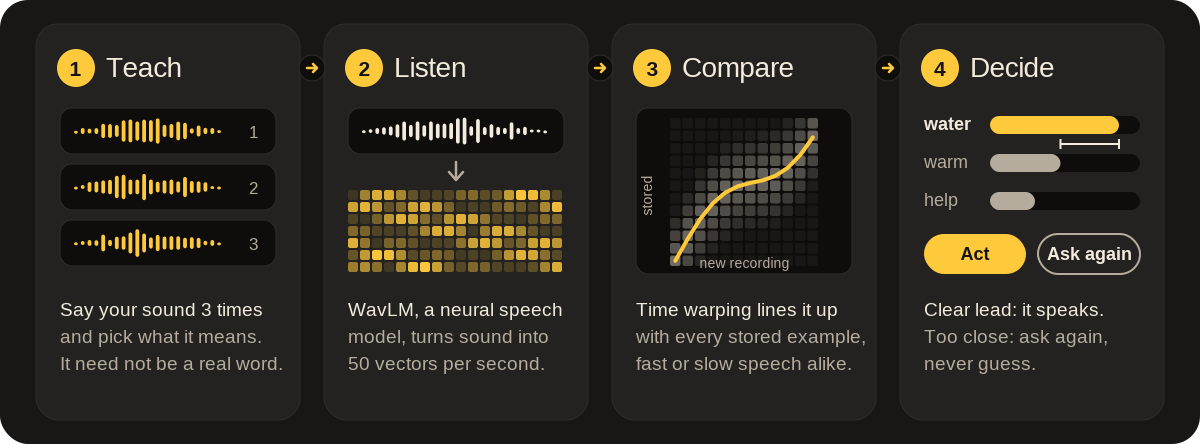
Four steps: teach three recordings, a neural speech model turns sound into vectors, time warping compares them with stored examples, and Utter acts only when one word clearly leads.

It runs, on real voices

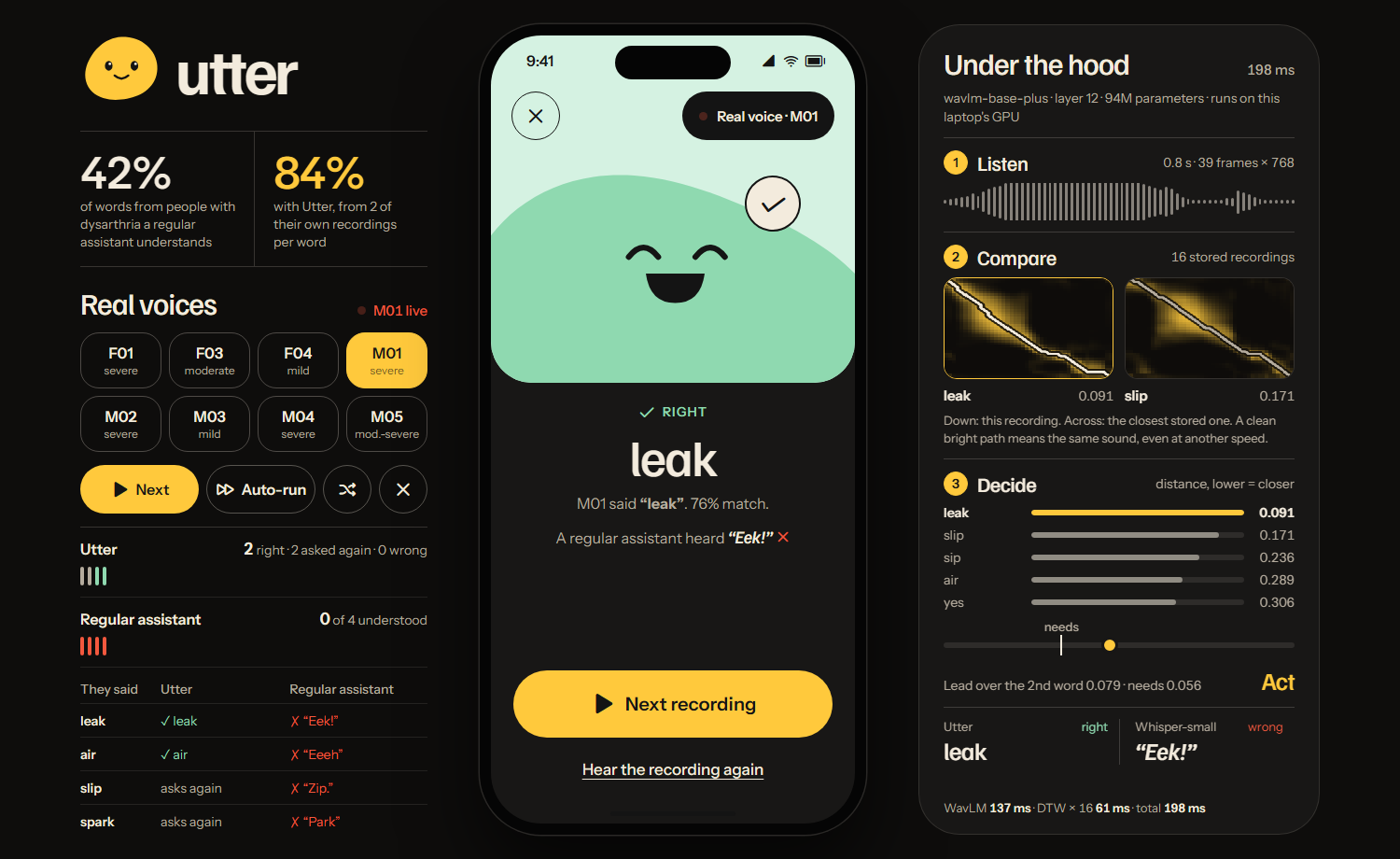
A screenshot of the real app. On the left it has learned 8 words of a real person with severe dysarthria and hears recordings it never heard before, next to a regular assistant. On the right the model shows its work.

The Utter app between two panels: a live test on a real speaker on the left and the model's internals on the right
The score on the left is counted live, including the mistakes. The panel on the right draws the alignment with the closest stored recording, the distance to every word and the lead Utter needs before it acts.

Teach

Pick a meaning and say your sound three times. It doesn't have to be a real word.

Speak

Say it. Utter shows its guess, and after you confirm, it says the whole sentence aloud.

Not sure

When two words are too close, Utter asks again. A wrong action is worse than no action.

Results

Share of words recognised correctly, averaged over 7 people with dysarthria (50 random sets of 8 words each).

Regular speech recognition (Whisper)
42%
Other people's recordings only
79%
The person's own 2 recordings only
74%
Utter: own + other people's recordings
84%

With "not sure" on: 71% correct, 24% asks again, 5% wrong. With shuffled labels accuracy falls to 10%, so nothing leaks from the test data.

Each person, in the running app

PersonDysarthriaWhisperUtter
F01severe11%75%
M01severe17%87%
M02severe24%73%
M04severe14%56%
M05moderate to severe46%74%
F03moderate50%57%
F04mild59%77%
M03mild70%91%

Top guess right on 508 unheard recordings, the person's own recordings only (2 per word, 1 for F01). This is the harder setting the app uses, so the mean is 74%, not 84%.

Real examples, side by side

Person saidWhisper heardUtter
sigh (M02)“Five.” ✗sigh ✓
read (F01)“Wee” ✗read ✓
spark (M01)“I” ✗spark ✓
know (M04)“No.” ✓knew ✗
storm (F01)“Bye.” ✗warm ✗

Where it fails: words that sound alike (know and knew, storm and warm). For M04 the app asks again for 82% of recordings instead of acting.

Get the app

The real recognition runs on your own computer, so no voice leaves it. On Windows it is one download and one double-click.

Needs Python 3.10 to 3.12, about 5 GB of free disk and an internet connection for the first start. A graphics card is not needed. Mac and Linux: sh start_utter.sh.

  1. Download the ZIP and unpack itRight-click the file and choose "Extract all".
  2. Double-click "Start Utter"The first start installs everything into the same folder and downloads the two models. It takes about 10 minutes.
  3. The app opens in your browserAllow the microphone, teach two words and say one. Next time it starts in under a minute.

Honest limits

Made by

Jonáš, Tomáš and Benjamín, for the Veritas AI International High School Hackathon 2026, track AI + Languages.